.png)
Hannes Wessels
12 Jun 2026
There is a mood in some circles that the captive lion and predator sector must simply be closed. Not fixed. Not raised. Not inspected properly. Closed. That is the demand, dressed up as science and repeated often enough to sound respectable.
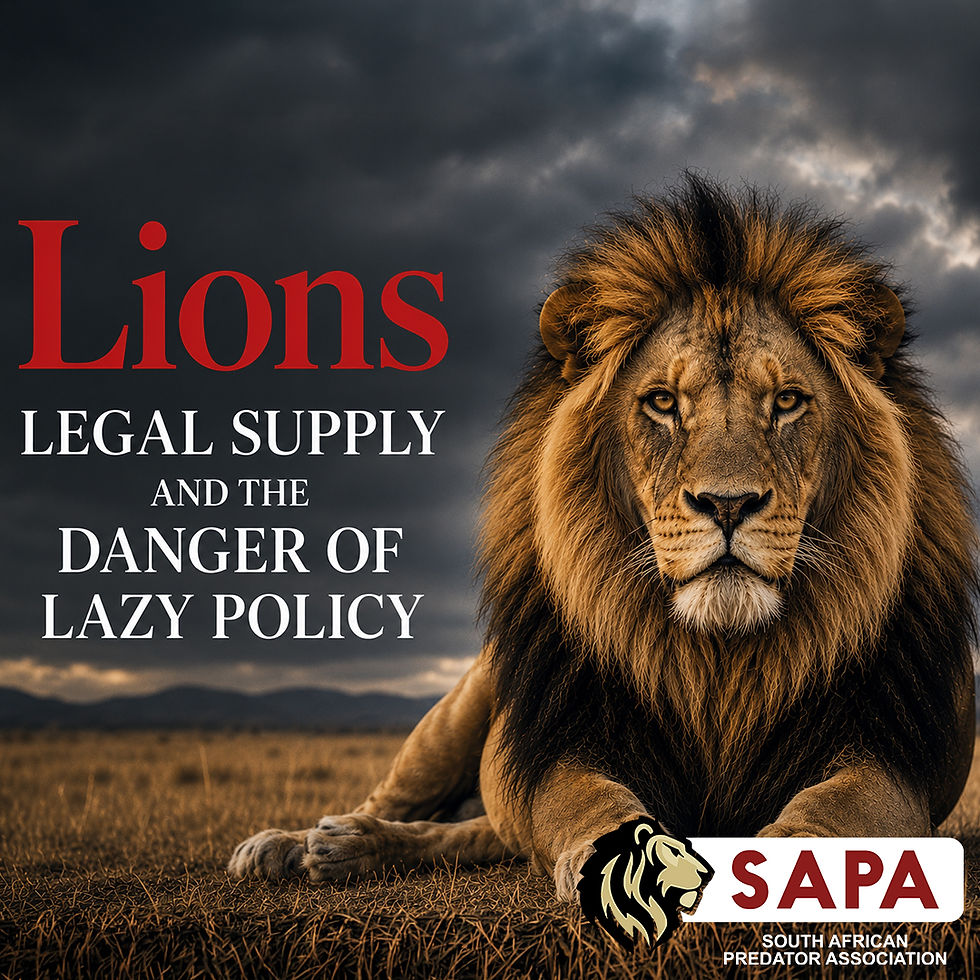
Lions, legal supply and the danger of lazy policy
by Hannes Wessels, President: South African Predator Association
There is a mood in some circles that the captive lion and predator sector must simply be closed. Not fixed. Not raised. Not inspected properly. Closed. That is the demand, dressed up as science and repeated often enough to sound respectable.
SAPA does not accept that. We do not accept it because it is unfair to the men and women who have carried lawful businesses under brutal public pressure for years. More importantly, we do not accept it because it may put wild lions at greater risk.
That last point must be said plainly. The risk to wild lions is no longer a theory written in a boardroom. It is showing up in the field.
The recent Endangered Wildlife Trust survey in the Nxanatseni South region of Kruger National Park was conducted because of increased poaching and poisoning incidents. The survey covered about 4,482 km2, drove more than 10,000 km in search of lions, and used modern spatial capture-recapture methods. It estimated about 155 lions older than one year in that region, at roughly 3.5 lions per 100 km2. That is useful work and SAPA does not dismiss it.
But buried in the careful language is the part that should worry every serious conservationist. During the survey, five identified study lions were found poached in Nxanatseni South. The report also refers to additional incidents in northern Kruger and across the border in Limpopo National Park. It says continued monitoring, stronger anti-poaching work and adaptive management are needed.
That is the uncomfortable fact. Wild lions in one of South Africa's most important lion landscapes are under real pressure from poaching and poisoning. Some people now seem reluctant to ask the next obvious question because the answer may not suit the politics of the anti-lion-breeding campaign.
What changed?
For years, the lawful sector supplied a legal, inspectable source of lion products from captive-bred animals. Those products were not taken from wild lions. They came largely as a by-product of legal hunting and legal breeding operations. That channel was not perfect. Nothing in the real world is. But it could be regulated, inspected, improved and traced.
Then the pressure campaign began to bite. In 2016, South Africa was given a CITES route for annual reporting and quota control for lion bones from captive-bred sources. In the same year, the United States stopped imports of hunted captive-bred lion trophies. The United States had been a major market for captive-bred lion hunting. When that hunting market collapsed, the by-product supply of bones also changed. Some breeders battled. Some tried other hunting markets. Some reduced. Some left. Some were pushed towards breeding for the bone market because legal supply had become constrained and prices rose.
Quotas were set in 2017 and 2018. Then came the Kollapen judgment in 2019. The court did not say South Africa may never set a quota. It found that the Minister had not properly taken welfare considerations into account when setting the quotas. That is a very different thing. The sensible response should have been to fix the process: include welfare, require proper inspections, apply strict conditions, use traceability, punish offenders and set a defensible quota if the evidence supported one.
Instead, the legal channel was effectively strangled. Now the same voices who helped dry up legal supply point to poaching pressure on wild lions and pretend there is no connection worth discussing. That is not science. That is selective curiosity.
The tree of knowledge has been eaten from. The taste is now inconvenient.
Why lions are vulnerable
Poachers do not need to take lions the way they take rhino or elephant. A lion can be poisoned. Poison is cheap. It can be laid in bait. It can kill a pride. It can kill vultures, hyenas, jackals and anything else that feeds on the carcass. The poacher does not carry the cost of the collateral damage. Conservation does.
That is why the anti-lobby's simple slogan of 'end breeding to save lions' is so dangerous. It assumes that demand disappears when legal supply is closed. We know better. Prohibition does not kill demand. It hands the market to criminals.
A lawful breeder must pay staff, feed animals, maintain fences, keep records, meet veterinary costs, deal with inspections and answer to permit conditions. A criminal with poison has none of those burdens. If government destroys the lawful sector while demand remains, it must explain who benefits. It will not be the wild lion.
This is where the real precautionary principle matters
The precautionary principle is being misused. It does not mean 'ban first and think later'. It does not mean that a legal sector can be destroyed because some people dislike it. Properly understood, it means that where serious environmental harm is possible, government must act carefully, rationally and proportionately.
That applies to change as much as it applies to existing activities. Closing a sector is not a neutral act. It has consequences. It can move animals into worse conditions. It can destroy traceability. It can remove lawful supply. It can raise illegal prices. It can push pressure towards wild lions. It can punish compliant operators while criminals carry on.
So let us ask the question that should have been asked years ago: what is the conservation risk of closing or freezing the lawful lion-breeding sector?
If the answer is 'we do not know', then the precautionary response is not a blind ban. The precautionary response is to regulate properly while the evidence is gathered. Raise the bar. Inspect. Audit. Trace. Licence only those who comply. Remove those who do not. That is responsible regulation.
What SAPA stands for
SAPA members know exactly how hard this fight has become. Many have lived for years with a sword over their heads. They have been called names by people who have never carried a feed bill, never managed a predator facility, never dealt with provincial permitting, never taken responsibility for animals in their care and never built anything that kept land and people in conservation.
We also know that the sector has had its problems. There is no point pretending otherwise. Bad operators harmed the reputation of everyone. Some historic practices deserved to be condemned. But it is dishonest to freeze those old images in time and use them to smear every current operator, especially those who have raised standards and asked for clearer rules.
SAPA's position is straightforward. We support a higher bar. We support transparency. We support traceability. We support enforceable norms and standards. We support proper inspections. We support action against operators who fail welfare, record-keeping or permit requirements. We support a sector that can stand in daylight.
What we reject is collective punishment. We reject a political campaign that treats every breeder as guilty before evidence is tested. We reject an illegal or semi-legal moratorium that quietly blocks new licences without the courage of a proper lawful decision. We reject policy made to satisfy foreign funders, social media outrage or politicians who know little about wildlife production in South Africa.
Ranchers and outfitters should pay attention
This is not only a lion-breeder issue. If a lawful sector can be strangled because activists do not like it, every wildlife rancher, outfitter, professional hunter and private conservation landowner should be concerned.
Today the target is captive-bred lions. Tomorrow it may be buffalo breeding, colour variants, intensive breeding, bowhunting, leopard hunting, elephant management, live sales, exports, game meat or any other part of the wildlife economy that offends an imported ideology.
The method is always similar. Find the worst example. Pretend it represents the whole sector. Ignore reform. Ignore property rights. Ignore rural jobs. Ignore the conservation value of private land. Then ask government to close rather than govern.
South Africa cannot afford that. Our conservation success has never come from slogans. It came from landowners carrying costs, taking risks and creating value in wildlife. Remove value and land-use changes. Remove legal markets and illegal markets grow. Remove private-sector confidence and conservation shrinks.
What must happen now
Government should stop hiding behind delay and pressure. It should bring the lawful sector into the room and do the hard work. Not a stage-managed consultation where the outcome is already written. A real process.
We need a licensing system that separates compliant operators from those who should not hold predators at all. We need traceability from birth to death and, where applicable, to product. We need welfare standards that are practical, inspectable and enforced. We need a lawful route for responsible trade where evidence supports it. We need data, not theatre.
We also need honesty from organisations that publish research. If a report records poached study lions, poisoning pressure and concern in Kruger, then the public deserves a serious discussion about why that is happening. It is not good enough to point only at habitat, water, community pressure or vague 'anthropogenic' factors while pretending that the collapse of legal supply cannot possibly matter.
SAPA is not asking government to look away from problems. We are asking government to look properly. Look at the whole risk. Look at the risk of action as well as inaction. Look at wild lions, captive lions, welfare, legal supply, illegal demand, rural jobs, land use and the rule of law. Then regulate like a serious country.
We will defend our members
To SAPA members and non-member breeders who have kept their heads down: now is not the time to disappear. The sector needs discipline, records, compliance and unity. The days of relying on informal arrangements are over. If we want to survive, we must be able to prove what we do, why it is lawful and why it matters.
SAPA will continue to press for raised standards and a defensible regulatory system. We will not defend the indefensible. But we will defend lawful breeders against lazy policy, activist distortion and political ignorance.
The anti-lobby has had years to tell the public that closing breeding will save lions. The emerging evidence says the story is not that simple. Wild lions are being poached. Poison is being used. Legal supply has been dried up. Demand has not vanished. Those facts belong in the same conversation.
If South Africa is serious about lions, it must stop confusing destruction with conservation. Fix the sector. Regulate it. Raise it. Trace it. Enforce against those who fail. But do not burn down a lawful, inspectable system and then act surprised when the smoke drifts into Kruger.
Sources and factual notes
Govaerts, A., Roodbol, M., Mthethwa, L.P., Nicholson, S., Roxburgh, L., Gopalaswamy, A.M. and Elliot, N.B. (2025). A Population Assessment of lions in the Nxanatseni South region of Kruger National Park (South Africa): Technical report on a lion survey conducted in 2024. Endangered Wildlife Trust. Key points used: survey area about 4,482 km2; survey effort 10,446 km; 182 detections of 74 identified lions; estimated density about 3.5 lions per 100 km2; concern over poaching and poisoning; five identified study lions found poached during the survey; further incidents reported in northern Kruger and adjacent Limpopo National Park.
Department of Environmental Affairs, 28 June 2017: 'Lion export quota for 2017 communicated to CITES Secretariat in line with CITES requirements.' The Department announced an export quota of 800 skeletons, with or without skull, from captive-bred lions and stated that trade was restricted to skeletons only.
National Council of Societies for the Prevention of Cruelty to Animals v Minister of Environmental Affairs and Others, Gauteng Division, Pretoria, 6 August 2019, Kollapen J. The court held that welfare considerations were relevant to the quota-setting decision and that the 2017 and 2018 quotas had not been lawfully set.
Williams, V.L. et al. (2021). Monitoring compliance of CITES lion bone exports from South Africa. PLOS ONE. Useful background on the legal captive-bred lion skeleton export system and compliance procedures in 2017 and 2018.
PDF Document -